
Bringing a medical device component from prototype to full-scale production requires careful planning, the right materials, and a manufacturing partner who understands the importance of meeting critical development deadlines.
At Extreme Molding, we've helped businesses across various industries navigate the challenges of product development and manufacturing. One recent project involved a complex medical device component that needed to move from initial samples to high-volume production, with projected demand reaching five million parts annually.
With an aggressive timeline and specific material requirements, a traditional manufacturing approach wasn't going to be enough. In this case study, we'll explore how our team used a three-stage silicone molding strategy to meet development milestones, manage tooling costs, and establish a scalable manufacturing solution.
The Challenge
Developing components for medical devices comes with unique challenges, particularly when it comes to material selection, precision, and production timelines.
For this project, the component required a pre-validated material, meaning material selection was already established and needed to remain consistent throughout development. Additionally, molded samples were required in just three weeks, leaving little time for traditional production tooling.
While the immediate priority was delivering samples for testing, the project also needed a manufacturing process capable of supporting projected annual demand of five million parts.
The challenge was finding a solution that could accommodate both short-term testing requirements and long-term production goals.
The Solution: A Three-Stage Approach to Silicone Molding
Rather than investing immediately in fully automated production tooling, our team developed a phased manufacturing approach that aligned with the project's timeline, budget, and anticipated production volumes.
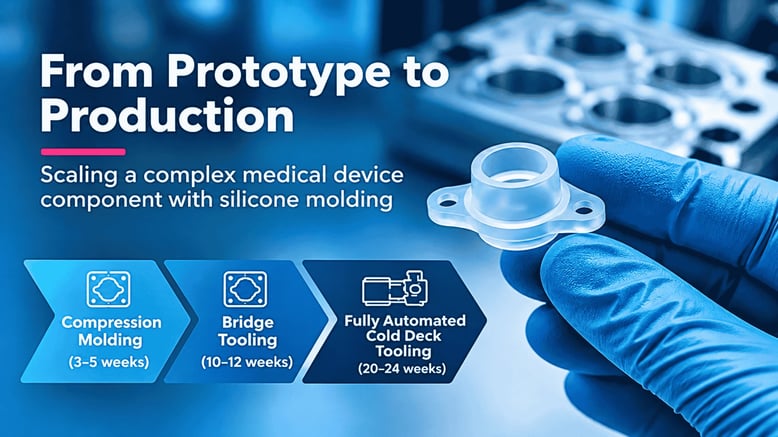
By transitioning through three distinct stages - compression molding, bridge tooling, and fully automated cold deck tooling - we were able to support each phase of development while preparing for future growth.
Stage 1: Compression Molding for Rapid Prototyping
Typical tooling timeline: 3-5 weeks
The first priority was producing molded samples as quickly as possible using the required pre-validated material.
Compression molding provided a practical solution for this initial phase. Compared to bridge tooling, compression tooling typically costs just 10-20% as much, making it an economical option for early-stage development.
This approach also allows manufacturers to use the same material intended for production, which is particularly valuable when working with medical device components that have specific material requirements.
Compression molding is generally well-suited for producing approximately 250–500 parts, providing enough samples for early evaluation without requiring a significant upfront tooling investment.
For this project, our team sourced a compression tool and successfully delivered molded samples within just three weeks, meeting the development deadline.
Stage 2: Bridge Tooling for Testing and Validation
Typical tooling timeline: 10-12 weeks
Once the initial samples were delivered, the next step was preparing for larger production volumes to support verification and validation (V&V) testing.
While compression molding worked well for the initial samples, the project required thousands of additional parts before transitioning to full-scale production.
Bridge tooling provided the ideal middle ground.
Typically costing 20-30% of a fully automated mold, bridge tooling allows manufacturers to increase production capacity without immediately committing to the investment required for high-volume manufacturing.
Depending on the application, bridge tooling can support production quantities ranging from approximately 10,000 to 150,000 parts.
For this project, we utilized low-cavitation bridge tooling to produce 15,000 parts for V&V testing within the following 16 weeks.
This intermediate stage allowed the development process to continue while the team prepared for the transition to automated production.
Stage 3: Fully Automated Cold Deck Tooling for High-Volume Production
Typical tooling timeline: 20-24 weeks
With the initial development and testing phases supported, the final step was transitioning to fully automated cold deck tooling capable of meeting long-term production demand.
For applications requiring hundreds of thousands or even millions of parts, this approach offers the efficiency and scalability needed for sustained production.
Cold deck tooling is designed to support high-volume silicone injection molding by keeping uncured material at a controlled temperature before it enters the heated mold cavities. This helps reduce material waste and supports efficient, repeatable production.
Although fully automated tooling requires a larger upfront investment and longer tooling lead times, it becomes increasingly valuable as production volumes grow.
For this project, we transitioned to fully automated cold deck tooling within the same 12-month period, establishing a manufacturing process capable of supporting the projected growth to five million parts annually.
By planning for high-volume production from the beginning, we helped create a smoother transition between development and manufacturing.
The Results
Through a phased approach to silicone molding, Extreme Molding successfully helped move a complex medical device component from initial prototyping to full-scale production.
The project achieved several important milestones:
- Rapid sample delivery: Molded samples were delivered within three weeks using compression tooling.
- Successful testing support: Bridge tooling enabled the production of 15,000 parts for verification and validation testing within the following 16 weeks.
- Scalable manufacturing: Fully automated cold deck tooling was implemented within the same 12-month period to support future production growth.
- Reduced investment risk: A staged tooling approach allowed manufacturing capabilities to expand alongside the project's development requirements.
- Long-term production readiness: The manufacturing program was established to accommodate projected annual demand of five million parts.
Most importantly, the project demonstrated that manufacturers don't always need to choose between speed, cost, and scalability. With the right strategy, it's possible to meet immediate development requirements while preparing for long-term production.
From Prototype to High-Volume Production
One of the biggest challenges in bringing a new medical device component to market is knowing when and how to scale production.
Investing in high-volume tooling too early can create unnecessary financial pressure, while relying on low-volume manufacturing for too long can limit growth.
At Extreme Molding, we understand that every product has different requirements. Whether you're developing initial prototypes, preparing for validation testing, or transitioning to high-volume manufacturing, our team can help determine the right tooling and production approach for your needs.
This project is a great example of how a strategic, phased approach can help manufacturers navigate complex development timelines while building a foundation for future growth.
Have a medical device component you're looking to bring to production? Contact us to discuss your project.
We're happy to explore how our silicone molding expertise can move your component into production.
November 3, 2026 |
Categories
Recent Posts
- From Prototype to Production: A Medical Device Manufacturing Case Study
- Silicone Elastomers for Medical Products
- Silicone Casting vs Injection Molding: Which One Is Right for You?
- Why FDA Regulations Matter in Medical Silicone Manufacturing
- Your Baby's Pacifier Might Not Be What You Think It Is
- Guide to Safe Baby Product Manufacturing in the USA
- Silicone vs Plastic for Your Dog Bowl: What Material Should You Choose For Your Product?
- LSR 2025 Insights + How Tariffs Impact Manufacturing
- Two-Shot Molding vs. Overmolding: What’s the Difference?
- From Breast Pumps to Nursing Pads: Why Silicone Is Ideal for Women’s Healthcare Products